
Key Parameters
- Test voltage, 50 Hz
- 2,500 V ACTest voltage, not rated voltage
- Minimum bending radius
- 6 × d
Construction
- Insulation resistance at 20 °C
- at least 6.1 MΩ·km
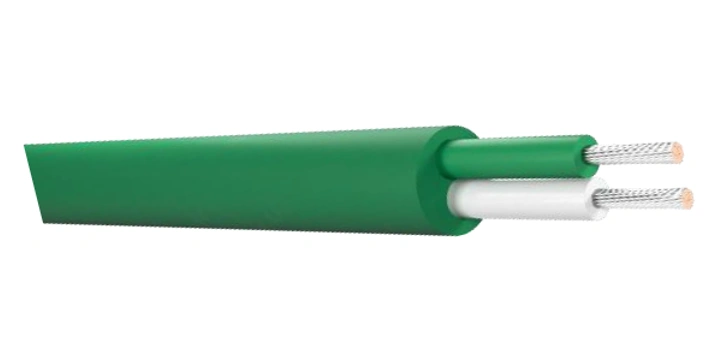
Conductors made of special metal alloys. Insulation and sheath: PVC, SiR, HFFR, FEP, PFA, glass fibre or basalt fibre. CuSn screen; FeZn or AISI 304 armour. Construction depends on the agreed specification.
Standards
IEC 584-3; DIN 43714; BS 1843; NF C 42-324; ANSI/MC 96-1
Application
Compensation and extension cables (thermoelectric) are an element of the measuring system connecting the thermoelectric sensor with the measuring device, e.g. a controller, indicator or temperature recorder..
Technical Tables
Material pairs and working temperatures
| Insulation / sheath | Temperature [°C] |
|---|---|
| PVC / PVC | −25…+105 |
| SiR / SiR | −60…+200 |
| HFFR / HFFR | −40…+120 |
| FEP / FEP | −90…+205 |
| PFA / PFA | −90…+260 |
| GL / GL | −60…+400 |
| BB / BB | −60…+750 |
These are not thermocouple measurement or compensation ranges. Mixed constructions require individual confirmation.
Available versions
The designation describes the thermoelement type, insulation, conductor construction, sheath, screen, number of pairs and conductor cross-section. The source scheme lists 1–8 pairs and 0.22; 0.5; 0.75; 1; 1.5; 2.5 mm². These values are not a promise that every combination is available. Final construction is agreed individually. Cable diameter is available on request.
Additional information
Source designation scheme
Example: JX FEP L SiR EK 1 X 2 X 0,5. Types in the scheme: JX, TX, EX, KCA, KX, NX, R/SCA, BC. D = solid conductor; L = stranded conductor. Screen/braid codes: Q = galvanised steel wire; EK = tinned copper wire. Other codes appearing in the TDS require confirmation.